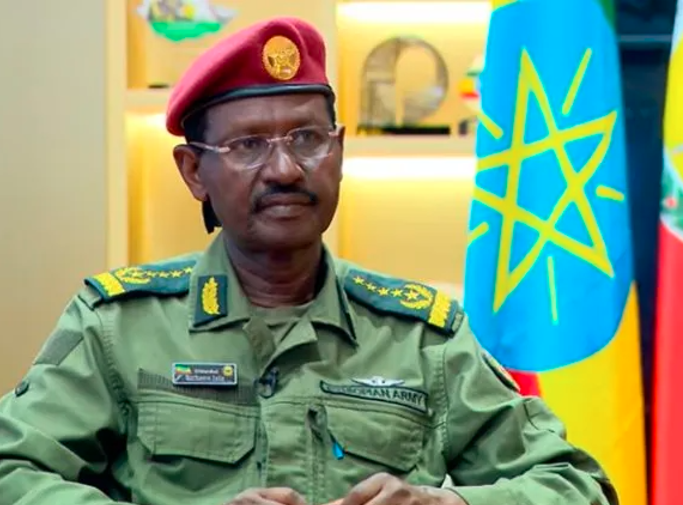
- Field Marshal Birhanu Jula says Ethiopia is confronting an externally supported security challenge; neighboring countries reject allegations as renewed fighting raises regional concerns
ADDIS ABABA: Ethiopia’s Chief of General Staff, Field Marshal Birhanu Jula, has warned of growing external involvement in the renewed conflict in northern Ethiopia, accusing Eritrea, Sudan and Egypt of providing support to armed groups opposing the federal government.
Speaking amid intensified fighting in the Tigray, Afar and Amhara regions, Field Marshal Birhanu said Ethiopia was confronting armed forces that, in his assessment, were organized and aligned with external interests. He specifically accused Eritrea of providing financial support to the Tigray People’s Liberation Front (TPLF), while indicating that Sudan and Egypt were also involved in supporting forces hostile to Ethiopia.
The Ethiopian military chief’s remarks come as fighting has again intensified in northern Ethiopia, reviving concerns over the fragile peace established after the 2020–2022 Tigray war.
Army Chief Raises Alarm Over External Interference
Field Marshal Birhanu said the TPLF and its allies would not be able to mount a sustained challenge to the Ethiopian state without external assistance.
He said Ethiopia was responding to the security situation with what he described as “wisdom and restraint,” while warning that outside support could complicate efforts to restore stability in the north.
The Ethiopian government has repeatedly expressed concern over the potential internationalization of the country’s internal conflicts, particularly amid growing tensions surrounding security, regional alliances and access to the Red Sea.
The army chief did not publicly provide detailed evidence for all of the allegations, which have been rejected by the countries named.
Renewed Fighting Tests 2022 Peace Agreement
The latest escalation follows the Pretoria Agreement of November 2022, which ended the devastating two-year war between Ethiopia’s federal government and the TPLF.
The renewed fighting has spread beyond Tigray into neighboring Afar and Amhara regions. TPLF-linked forces and allied groups have captured or contested several strategically important locations, while federal forces have mounted counteroperations.
The developments have raised fears that the conflict could once again develop into a wider national crisis, particularly given the involvement of multiple armed groups and the region’s complex political and security environment.
Ethiopia Faces Denials From Neighbors
Eritrea has rejected Ethiopia’s accusations, with Eritrean officials arguing that Addis Ababa is shifting responsibility for the renewed tensions.
Sudan’s armed forces have also categorically denied supporting forces fighting the Ethiopian government, describing the allegations as baseless. Khartoum has instead accused Ethiopia of supporting armed groups opposed to the Sudanese military, allegations Addis Ababa has rejected.
Egypt has not publicly responded to the accusations reported in connection with the latest escalation.
Strategic Red Sea and Regional Tensions
The renewed confrontation is unfolding against a backdrop of wider geopolitical tensions in the Horn of Africa.
Ethiopia’s efforts to secure reliable sovereign access to the Red Sea have contributed to heightened tensions with Eritrea and Somalia, while Ethiopia’s relations with Sudan have also been complicated by the continuing Sudanese conflict.
These overlapping disputes have increased concerns that developments inside Ethiopia could have consequences beyond its borders, particularly in a region already facing multiple security and humanitarian crises. The escalation has also raised serious humanitarian concerns.
Doctors Without Borders (MSF) reported a sharp increase in wounded patients arriving at hospitals in northern Ethiopia. The number of patients at hospitals in Korem and Alamata reportedly increased from about 180 to more than 420 within 48 hours, while hundreds more wounded people were reported at Suhul Hospital.
Aid organizations and international officials have urged the parties to prevent further escalation and protect civilians as fighting continues. The Ethiopian government’s warnings about external involvement underline the increasingly complex security environment facing the country.
While the allegations against neighboring states remain disputed, the renewed conflict demonstrates the fragility of the post-2022 peace process and the potential consequences of unresolved political and security tensions.
A renewed commitment to dialogue, respect for Ethiopia’s sovereignty and territorial integrity, and regional cooperation could be important to preventing the latest escalation from developing into a broader conflict across the Horn of Africa.
BY: The Times Union