- Trump and Xi Extend Economic Pause, but Tensions Over Trade, Technology and Taiwan Persist
- Analysts Warn Temporary Stability May Prove Difficult to Sustain Without Further Concrete Agreements
WASHINGTON: The United States and China may have secured a temporary reprieve from escalating trade tensions after President Donald Trump and Chinese President Xi Jinping agreed to extend their economic truce, but analysts caution that the broader strategic rivalry between the world’s two largest economies remains unresolved.
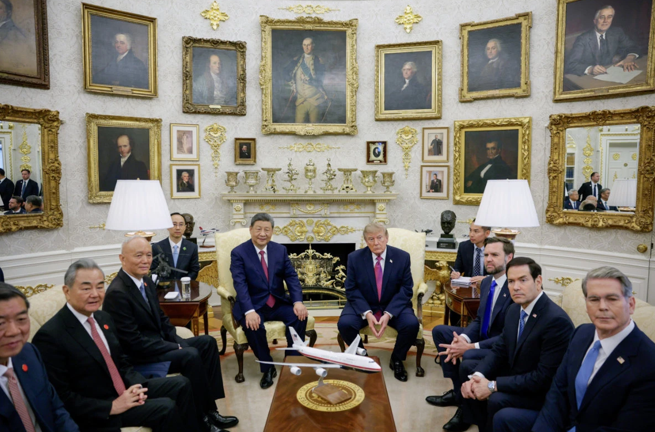
Trump and Xi concluded a high-profile summit on Friday, with the US President confirming that the two leaders are expected to meet twice more this year. The meetings are intended to maintain dialogue amid continuing disagreements over trade, technology, Taiwan, defence, rare earths and industrial policy.
Despite the positive tone surrounding the summit, Daniel Russel of the Asia Society Policy Institute said the two countries remain engaged in “a bitter competition” across several strategic areas.
Daniel Kritenbrink, a former US official who is now with consultancy The Asia Group, said both leaders appeared interested in maintaining stability in bilateral relations at least through the end of the year.
However, he stressed that a longer-term extension of the current truce would require further tangible results and greater implementation of existing commitments.
Trade Truce Extended Until January
Trump and Xi had agreed to a trade truce last year during a meeting in South Korea, following a sharp escalation in the tariff dispute between Washington and Beijing, with tariffs at one point exceeding 100 percent.
Under the agreement, China committed to increasing purchases of US agricultural products, including soybeans, while also suspending restrictions on rare earth exports for one year.
The arrangement was originally scheduled to expire in November. However, US Treasury Secretary Scott Bessent said the two sides had agreed this week to extend the truce until January 10.
US Trade Representative Jamieson Greer told CNBC that Washington views such extensions as periods during which compliance with the agreement can be assessed.
Washington Seeks Greater Compliance
Analysts said the short extension reflects continuing US concerns about China’s implementation of previous commitments.
Kritenbrink said US officials believe Beijing has done enough to maintain the agreement but has not gone significantly beyond its minimum obligations, a situation he described as difficult to sustain over the long term.
Mary Lovely of the Peterson Institute for International Economics said the shorter extension was the preferred position of the US side, while Beijing would have favored a longer rollover.
She linked Washington’s position in part to concerns over China’s supply of rare earth magnets, suggesting that US officials want to maintain close oversight of the issue.
Lovely also questioned whether the threat of substantially higher tariffs continues to provide Washington with the same leverage over Beijing as it did during earlier stages of the trade dispute.
Economic Cooperation Continues Despite Rivalry
Greer said the two countries had made progress on several additional economic issues and that further details were expected to be released Monday.
He said Washington and Beijing were discussing arrangements that would allow certain categories of goods to receive more favourable trading treatment, while also identifying products that could potentially be excluded from future trade disputes.
Greer is scheduled to host G20 trade ministers in Wisconsin next week, where US tariff policy and concerns over excess industrial capacity in China are expected to feature prominently in discussions.
US-China Dialogue Expands to Artificial Intelligence
The two countries have also agreed to establish a mechanism for notifying each other about potentially serious artificial intelligence-related threats, Bessent said.
Peter Richardson of Counterpoint Research said the mechanism could potentially involve a direct hotline or another rapid communication channel, although determining what constitutes an AI-related incident requiring notification could prove challenging.
He noted that it can be difficult to establish quickly whether an AI incident resulted from government action, an independent actor or an accident.
Richardson said the initiative was unlikely to produce a comprehensive international framework for AI regulation given the broader strategic rivalry between Washington and Beijing, but could nevertheless establish an initial practical safeguard.
Kritenbrink similarly said the summit had not diminished the competitive dynamics between the two countries in artificial intelligence.
“I don’t think you’ll see any slowing down,” he said.
Strategic Rivalry Remains the Larger Challenge
While the latest agreement provides Washington and Beijing with additional time to manage their economic differences, analysts say the fundamental sources of competition remain firmly in place.
Trade and tariff disputes have increasingly become intertwined with wider disagreements over advanced technology, critical minerals, industrial policy, Taiwan and defence.
The extended truce therefore offers a period for further negotiations, but the durability of the broader US-China relationship will depend on whether the two governments can translate temporary economic arrangements into more lasting and verifiable agreements.
BY: The Times Union