Nothing is new this summer; we have all been here before. Yes, airport delays are common in most Western countries during the height of the holiday season. Wars in the Middle East, too, have surely rendered some vacation plans unfeasible, uncertain or more expensive.
But we all attempt to deal with the risks and overcome them, one way or another, and find alternative destinations or amend our plans. Even as we have seen Bordeaux in France or the suburbs of Madrid in Spain engulfed in wildfire flames in recent days, I am sure many of us looked elsewhere and did not gave the matter more than a shrug as we searched for alternative destinations. This is human nature, human resilience, and force of habit.
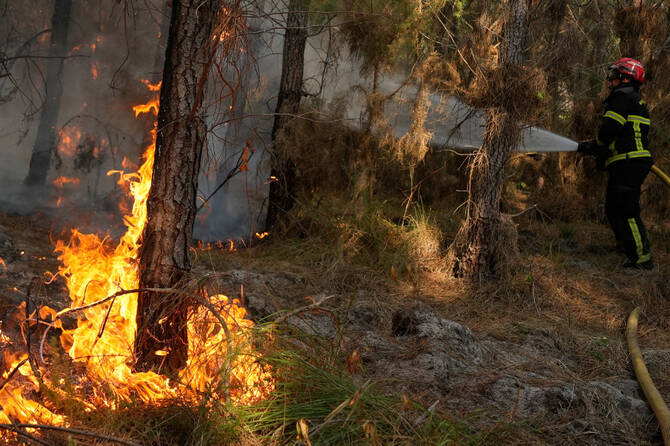
But the wildfires in France are extremely dangerous, and rare in terms of their nature and unpredictability, and that should give us all pause. They are displaying, experts say, an unusual phenomena called pyrocumulonimbus, in which the heat from strong blazes can generate “fire clouds,” resulting in thunderstorms and lightning strikes that cause the fires to more easily leap across rivers and wide roads despite the best traditional containment efforts by brave firemen, who are aided by planes and heavy equipment.
This is not simply the result of the rise in temperatures in a warming world; there are also the atmospheric changes and shifts in surface weather patterns that come with it. This spate of wildfires in Europe is happening as large parts of the continent have been hit by successive heatwaves that have left extensive woodland areas extremely dried out.
The blazes tearing across southwestern France have been supercharged, then, by these so-called fire clouds as a result of wildfires so intense they form their own thunderstorms. They are typically accompanied by winds of more than 100 mph and heat so strong it is impossible for firefighters to get close. This phenomenon was previously seen in Australia’s so called “Black Summer” of 2019-2020, and California in 2022.
Meanwhile, as fires fed on hectare after hectare of dry vegetation and forests in Spain and France this week, unseasonable snow and rain fell in Greece and other parts of the Eastern Mediterranean thanks to more bizarre weather patterns.
Many would argue that it is summer in the Northern Hemisphere and even if some blazes are unusually violent and deadly, this is wildfire season so it is not uncommon. However, it is not normal for key European capitals such as Madrid to have a major brush with wildfires. Nor is it okay that hundreds of thousands of people have had to flee their homes in and around the world capital of wine making in southwestern France.
And it is simply unfathomable that US President Donald Trump would vow to impose tariffs on Canada in retaliation for smoke from wildfires that had drifted over the border, instead of rushing to send scientists and firefighting teams to help contain the blazes, limit the damage, and protect Canada, the US, and the wider planet.
But we are, it seems, in an age of conflictive geopolitics in which wildfires can be added to the long lists of causes for conflicts across borders, alongside the more usual and common causes fueling the wars raging between Russia and Ukraine, the US and Iran, or in Gaza.
The blazes tearing across southwestern France have been supercharged by the so-called fire clouds.
Mohamed Chebaro
But should disasters such as wildfires not serve as stimuli, now more than ever, for nations and their leaders to realize that efforts must be made to deal not only with the root causes of wars and the conflictive geopolitics that lead to confrontations, but also with issues such as global warming and climate change, and the role of humans and states in efforts to reverse such deadly trends.
The French fire service described their efforts to control the blazes as a herculean battle. The scale of the fires is such that French President Emanuel Macron assembled his National Security Council. Spanish Prime Minister Pedro Sanchez warned against “climate denialism,” which he described as “the worst of fuels in the face of the climate emergency.”
Heat waves in Europe this summer have prompted families and local authorities to scramble for cooling systems and infrastructure upgrades in a time of economic hardship and shortages of funds everywhere. But what is needed most, perhaps, is stronger political will and a lot more of it, not only in Europe and the Western world but globally.
A recent report by the British military offered a damning assessment of the future and the effects of climate change on security, and that is maybe why it was initially withheld. It warned that rising temperatures pose threats to the UK and the wider world on an unprecedented scale: nations might not be able to feed their peoples and gross domestic product could be hit twice as hard as it was during the financial crisis.
The report also highlighted the increasing pressure that would be caused by migrants moving around the world as their own countries become too hot to live in, or to produce the food they need to survive.
Maybe the military analysts were exaggerating the risks. Maybe all we have witnessed in the past two decades can be dismissed as a few years of bad weather. But let us at least look at temperature rises in a sober, rational manner before it is too late, and admit that climate risks have become a clear, present, and persistent danger.
In the face of increasingly extreme weather patterns, from torrential downpours to heat waves, the world needs to heed scientific studies and modeling by experts so that we are better prepared to protect the planet and ensure the survival of all its species.
Wildfires in France, Spain, Canada, China, and Portugal have destroyed crops on a vast scale; Goldman Sachs anticipates that food prices could rise by 16 percent over the next two years as yields diminish by 20 percent as a result of the heat, as well as water shortages.
But all is not lost. Many people still believe such adversities can be overcome, in the UK and worldwide, if we abandon our complacency and pursue policies designed to help us transition to a greener and cleaner world by 2050.
Advanced technologies, and strong political leadership that harnesses goodwill and redirects funds away from war and conflict toward development, could still offer us all a chance. Maybe.
Writing that last sentence made me feel as if I am being naive. But it must be written nonetheless, because it is the only possibility for a better future.
BY: Writer Mohamed Chebaro is a British-Lebanese journalist with more than 25 years of experience covering war, terrorism, defense, current affairs, and diplomacy.
Disclaimer: Views expressed by writers in this section are their own and do not necessarily reflect The Times Union‘ point of view