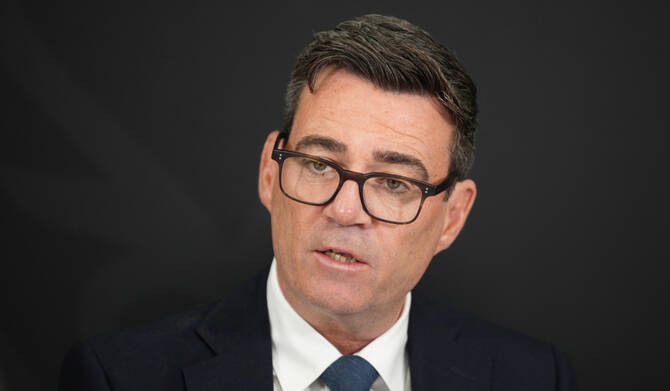
On Monday, there was a leadership change in the UK. Andy Burnham, who until recently served as mayor of Greater Manchester, has become the new prime minister. Although the downfall of his predecessor, Keir Starmer, and Burnham’s rise to power were driven largely by domestic issues such as the economy, the rising cost of energy and inflation, the new PM will not be able to avoid the major geopolitical challenges confronting Britain. The events of his first 24 hours in office served as a reminder of that reality.
Just a few hundred kilometers southwest of London, where Burnham addressed the nation outside 10 Downing Street, a Russian warship provocatively conducted a live-fire exercise off the coast of Plymouth. More than 2,000 km to the east, a Royal Air Force reconnaissance aircraft carried out a deep patrol over the Black Sea for the first time in months.
Meanwhile, back in England, US bombers continued to depart from British bases to conduct airstrikes against Iran. Burnham’s first phone call with President Donald Trump reportedly focused on issues including Iran and efforts to secure and de-mine the Strait of Hormuz. Downing Street has also made it clear that there will be no major changes to allowing American forces to continue using British bases.
Burnham has yet to articulate a comprehensive foreign policy vision of his own but current events leave little room for sweeping changes in the UK’s international posture.
Downing Street has made it clear there will be no major changes to allowing US forces to continue using British bases
Luke Coffey
There is, however, one area where change is urgently needed: defense spending. This issue will receive even greater scrutiny in the aftermath of the recent NATO Summit in Ankara, Turkey.
Although rising public discontent over the economy, the cost of living and inflation created the conditions for Starmer’s downfall, one could argue that it was the resignation of Defense Secretary John Healey over the issue of defense spending that triggered the political crisis leading to his ouster.
London’s current approach to defense spending has left much to be desired. At last year’s NATO Summit in The Hague, the alliance’s leaders agreed to work toward spending 5 percent of gross domestic product on defense and defense-related investments by 2035. Of that total, 3.5 percent would be devoted to core defense spending, while the remaining 1.5 percent would fund national resilience efforts.
In Ankara, leaders were expected to provide a more concrete roadmap for reaching that goal over the coming decade. With Starmer’s political future increasingly uncertain and difficult decisions likely to fall to his successor, the government instead chose to defer the issue.
The UK currently spends about 2.3 percent of GDP on defense. Starmer’s government had formal Treasury-backed plans to increase that figure to only 2.68 percent by 2030. When Healey resigned, he argued that Britain needed to spend at least 3 percent of GDP by 2030 to meet the country’s security requirements.
This new administration will be judged by whether it provides the resources necessary to fulfill Britain’s defense commitments
Luke Coffey
This is where Burnham’s new government faces its greatest political test.
In a twist of political irony, Healey, who resigned over inadequate defense spending, has now been appointed chancellor of the exchequer and will oversee the Treasury, which controls government spending, including defense. Meanwhile, Wes Streeting has become the new defense secretary. His appointment is notable because Streeting was widely regarded as Burnham’s strongest rival for the Labour leadership. Clearly, a political accommodation was reached in which Streeting remained outside the leadership contest before being rewarded with one of the most senior positions in government.
The chancellor must now translate his previous rhetoric on defense spending into action. Likewise, the new defense secretary, owing his appointment to the new prime minister, must ensure that the UK develops a sound defense strategy that is matched by the resources required to deliver it.
Yet there remains a fundamental flaw in the country’s current approach to defense planning.
Starmer’s government completed its “Strategic Defence Review” months before publishing a credible long-term investment plan explaining how the review’s ambitions would be funded. In an ideal world, those two exercises should have been conducted simultaneously. Strategy and resources are inseparable. Determining what Britain’s armed forces should be expected to do without first establishing how those capabilities will be financed inevitably produces unrealistic expectations and unfunded commitments.
The result has been a lopsided approach to defense policy that recent political events have shown to be unsustainable.
Burnham should therefore announce that the review published in June 2025 will be updated alongside a revised Treasury investment plan so that strategy and funding are fully aligned. Whether this takes the form of a new government white paper on defense spending or simply an additional chapter to the existing review is less important than ensuring the two documents are developed together rather than in isolation.
Unless Britain’s assessment of its defense posture is coordinated with a realistic plan for financing those ambitions, the country will continue to suffer from the same underlying problem: resources that fail to match strategic objectives.
Burnham must address this quickly. London remains one of Europe’s leading military powers and one of NATO’s most important members. It has played a central role in supporting Ukraine against Russian aggression since Russia’s full-scale invasion in 2022 and continues to make major contributions to NATO’s deterrence posture, particularly in the Baltic region.
Allies and adversaries alike will be watching closely. From Washington to Moscow and in capitals across Europe, governments will judge this new administration not by its rhetoric but by whether it provides the resources necessary to fulfill Britain’s defense commitments.
Politics rarely offers a second chance to correct a major policy mistake. Burnham now has that opportunity. He should seize it by putting Britain’s defense strategy and defense spending on a sustainable footing that matches the country’s ambitions and responsibilities.
BY: Luke Coffey is a senior fellow at the Hudson Institute.
Disclaimer: Views expressed by writers in this section are their own and do not necessarily reflect The Times Union‘ point of view