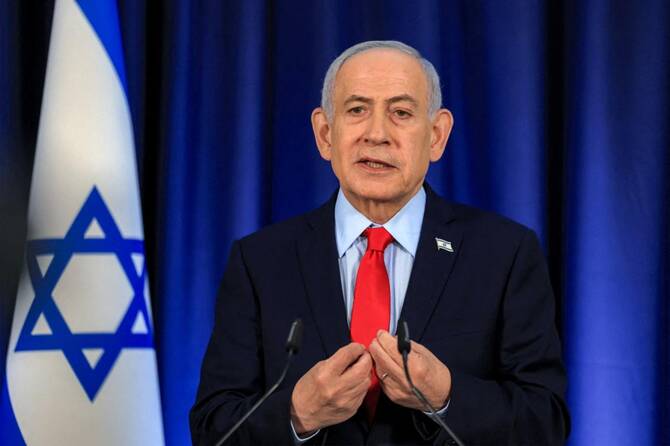
- Defense Spending Surges as Netanyahu Pushes “Super-Sparta” Vision
JERUSALEM: The escalating financial burden of Israel’s multi-front war and Prime Minister Benjamin Netanyahu’s push to transform the country into a “super-Sparta” of the Middle East are driving a sharp rise in defense spending, fueling concerns over potential cuts to education, healthcare, and other public services.
According to Bank of Israel Governor Amir Yaron, the combined cost of the interconnected regional conflicts that began after Hamas’s October 7, 2023 attack had reached approximately 405 billion shekels ($138 billion) by late April.
“That is a massive figure, representing more than 17 percent of GDP,” Yaron said at an economic conference in Herzliya, north of Tel Aviv.
War with Iran Adds Billions to State Expenses
The latest military confrontation involving Iran has further intensified pressure on Israel’s finances.
The campaign, which began after a series of US-Israeli strikes on February 28 and ended with a ceasefire on April 8, added an estimated 35 billion shekels ($12 billion) to state expenditures, according to an initial assessment by Israel’s Finance Ministry.
Following approval of the 2026 budget in March, the government acknowledged that the defense ministry’s budget had more than doubled since the beginning of the war in October 2023.
To finance the prolonged military operations, Israel significantly increased borrowing on international markets during 2024 and 2025.
As a result, public debt has climbed to more than 69 percent of GDP, compared with around 60 percent before the war, according to Treasury figures. Taxes and social security contributions have also been raised to help cover the growing costs.
Economists Warn of Pressure on Living Standards
Economists say Israelis are facing a dual economic burden from the ongoing conflict.
Esteban Klor, an economics professor at the Hebrew University of Jerusalem, said citizens are effectively “paying twice” for the war — through reduced public spending and slower economic growth.
He warned that repeated budget cuts could weaken essential services, saying education quality, infrastructure investment, and healthcare performance could suffer as government resources shift toward defense.
Although Israel’s economy recovered faster than expected after the initial shock of the war, the continued mobilization of tens of thousands of military reservists has created additional strain.
“Many workers are serving in the army rather than being at their jobs, which affects production,” Klor said.
A survey released by the Israel Democracy Institute on June 1 found that 31 percent of respondents reported a decline in wages or income since October 7, 2023.
The impact has been particularly severe among self-employed workers and lower-income groups.
Finance Officials Caution Against a “Trauma Economy”
At the Herzliya conference, Tamar Levy-Boneh, deputy head of budgets at Israel’s Finance Ministry, warned against the emergence of what she described as a “trauma economy.”
She said the shock of the October 7 attack could lead to continuous demands for higher military spending, potentially creating a cycle in which security priorities undermine economic stability.
“The security establishment must meet its needs in a way that does not damage living standards and must take responsibility for its share,” Levy-Boneh said.
Netanyahu Calls for Greater Military Self-Reliance
Netanyahu has promoted a different approach, arguing that Israel must become a “super-Sparta” — a reference to the ancient Greek city-state known for its military-focused society.
The Israeli prime minister has said the country needs to reduce its dependence on foreign military assistance, particularly from the United States, and strengthen its domestic defense industry.
On May 3, Netanyahu pledged to invest 350 billion shekels over the next decade in Israel’s defense sector, aiming to secure what he called “overwhelming aerial superiority.”
However, economists have warned that continued expansion of defense spending could push the military budget above 10 percent of GDP, a level they say may be difficult to sustain.
Rising Inequality and Poverty Concerns
The prolonged conflict is also worsening social and economic inequalities.
Israel already faces significant income disparities, and recent data from the National Insurance Institute showed that the percentage of children living below the poverty line increased from 27.6 percent in 2023 to 28 percent in 2024.
Analysts caution that balancing national security needs with economic stability will remain one of Israel’s biggest challenges as the war’s financial consequences continue to unfold.
BY: The Times Union