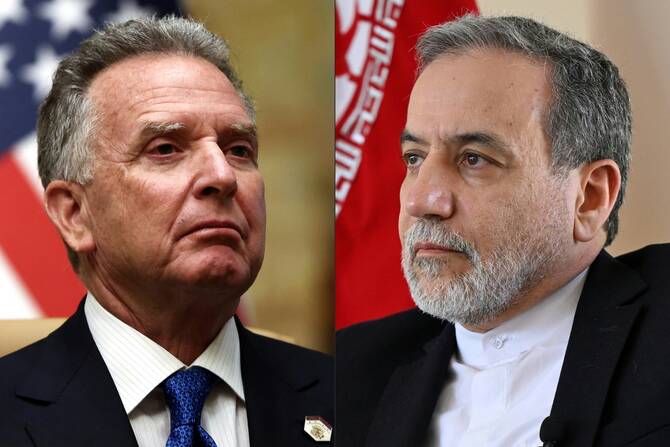
The first round of the latest series of talks between the US and Iran appears to have progressed in Oman. Further negotiations are slated for this week. Hope lingers.
The prize is huge. An Iran that no longer pursues a nuclear path would be a major victory for nuclear disarmament at a time when Russia and the US no longer have any nuclear arms treaties binding them.
Failure looks as if it would trigger war in the form of US military strikes. President Donald Trump has the military capabilities assembled in the region.
War is always risky. War never has many certainties. Trump knows full well that kicking off a war is far easier than ending one. War may happen soon by design but also as a result of a flashpoint, a misunderstanding between sides where trust is extinct.
What would be bombed? What would be the objective and would it be in any way achievable? It is unlikely Trump would sanction strikes to achieve regime change, as he knows this does not tend to happen. But an epidemic of wishful thinking still infects the thinking of too many external fly-by-night observers.
Degrading Iran’s capabilities is conceivable — for example, a decapitation strike. But this is not simple and, as with any strikes, civilian casualties could mount up. And how long would the strikes last — days, weeks or months?
An epidemic of wishful thinking still infects the thinking of too many external fly-by-night observers
Chris Doyle
The Iranian leadership has some unsavory options in a full-blown war scenario. Ballistic missiles may still be dispatched toward Israel. Blocking the Strait of Hormuz, even partially, is another possibility, causing an immediate and damaging hit to the global economy. One can only guess at the sleeper cells Iran might unleash if the regime’s survival is threatened. To counter that, proponents of military action may argue that many of the worst-case scenarios did not materialize in last year’s 12-day war. This time around, however, the Iranian leadership may see it as a fight to the death.
All this is happening in the wake of arguably the largest protests in recent Iranian history and the subsequent brutal crackdown, which killed thousands. A war will not reincarnate the thousands killed in the protests. For those Iranians dreaming of regime change, bombing from on high has a patchy record of success. Many envisage a large portion of Iranians closing ranks in the face of any US or US-Israeli strikes on Iran. It risks a “blitz” effect, whereby Iranians may tap into patriotic, nationalistic feelings. Many Iranians want to be able to handle their domestic challenges internally.
Let’s face reality. There are zero easy fixes for all the issues involving Iran. Every option has risks. Regime collapse could see the end of the Iranian state, with an enduring breakdown of law and order leading to a huge refugee crisis and interethnic strife. With Iran’s population of nearly 100 million and numerous identity groups, this would make the Iraq and Syria crises look like minor squabbles.
Collapse could see some form of military takeover, with the removal of the theocratic classes from power. A deal could ensure regime survival, even its prolongation, which would not be attractive to those that oppose it.
One risk is that a deal is done too hastily and is not properly worked out, left riddled with holes and gaps
Chris Doyle
What about a deal? Time will be pressing. Trump is clearly not going to wait months, maybe not even weeks. He is pressuring other states to end their business dealings with Iran, threatening a 25 percent tariff on those that continue such trade. One risk is that a deal is done too hastily and is not properly worked out, left riddled with holes and gaps. A weak deal could be one of the worst outcomes. The Iranian negotiators could have alternative careers as poker players.
What might a deal include? It could be narrow or broad; partial or full. In public, both sides proclaim their red lines. Iranian officials claim that any deal will only focus on the nuclear issue. The Trump administration insists Iran’s ballistic missile program and regional conduct are also on the table. One assumes a major freeze on its nuclear program leading to its dismantling is a core part of any draft, with sanctions relief included.
But is a broader deal possible? The Iranian leadership has relied on its allies across the region, from Hezbollah to Hamas and the Houthis, as a deterrent to military strikes and a means to disrupt whole swathes of the Middle East. Lebanon, Syria, Iraq, Palestine and Yemen would benefit massively from less Iranian interference. It costs the Iranian regime too, as sustaining these groups is a drain on its depleted financial resources.
Perhaps the greatest unknown is, as ever, the array of ambitions among the Iranian leadership, often stubborn to extreme, unwilling to be seen to cave in to external bullying. All should be wary of running the clock down on a negotiated path forward.
If “sense” and “sanity” made decisions, an Iran deal would have been signed ages ago. Trump craves a deal. The Middle East wants to see a nuclear-free Iran playing a responsible role in the region, not an inflammatory one. Iranians crave sanctions relief, for their economy to lift off and for the horrors of war to be avoided.
BY: Writer Chris Doyle is director of the Council for Arab-British Understanding in London.
Disclaimer: Views expressed by writers in this section are their own and do not necessarily reflect The Times Union‘ point of view