WASHINGTON – The last remaining nuclear weapons treaty between the United States and Russia expired Thursday, marking the first time in over five decades that the countries will be without a legally binding framework to control such arsenals, raising the risk of a new global arms race.
The expiry of the New Strategic Arms Reduction Treaty, which entered into force in 2011, comes amid increasing geopolitical uncertainty, driven by factors such as U.S. President Donald Trump’s “America First” agenda and China’s rapid military rise.
Russia’s Foreign Ministry said in a statement Wednesday that the two countries are no longer bound by the treaty’s obligations and “in principle free to choose their next steps.”
Under the treaty, known as New START, the United States and Russia were each limited to no more than 1,550 deployed nuclear warheads, 800 deployed and non-deployed launchers, and 700 deployed delivery vehicles, including intercontinental ballistic missiles and heavy bombers equipped for nuclear weapons.
After the United States, during Trump’s first presidency, withdrew from the Intermediate-Range Nuclear Forces Treaty in 2019, citing violations by Russia, New START became the only remaining arms control accord between Washington and Moscow.
On the expiration, U.N. Secretary General Antonio Guterres issued a statement saying it represents a “grave moment” for global peace and security.
“This dissolution of decades of achievement could not come at a worse time — the risk of a nuclear weapon being used is the highest in decades,” Guterres said, while pressing the United States and Russia to immediately negotiate a successor arms control framework.
New START was signed in 2010 and entered into force in February the following year, with an initial duration of 10 years. In 2021, weeks after Joe Biden took office as Trump’s successor, the two countries extended the pact for five years through Feb. 4.
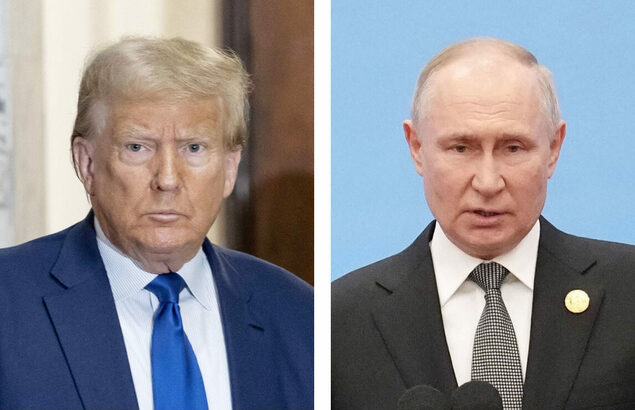
Russian President Vladimir Putin, however, announced the suspension of his country’s participation in the pact in February 2023, a year after its full-scale invasion of Ukraine began.
In September last year, Putin proposed an additional one-year extension of the accord’s central limits to allow time for further negotiations, provided the United States did not take steps that would undermine the existing deterrence balance.
Russia has said the United States did not respond to Putin’s proposal.
For his part, Trump has insisted on the inclusion of China, which has been rapidly expanding its nuclear capabilities, in any future negotiations on arms reduction.
China has consistently rejected the idea of trilateral disarmament talks, saying its nuclear arsenal is far smaller than those of the United States and Russia, which together possess about 90 percent of the world’s nuclear weapons.
Chinese Foreign Ministry spokesman Lin Jian said at a press conference Thursday that Beijing finds the treaty expiration “regrettable” and called on Washington to resume dialogue with Moscow on its proposal.
Lin added China’s nuclear strength is not at the same level with that of the United States and Russia and that the Asian country “will not participate in nuclear disarmament negotiations at the current stage.”
He stressed Beijing keeps its nuclear capabilities “at the minimum level required by national security” and has no intention to engage in an arms race with any country.
Meanwhile, Russia has long argued that any future arms control treaty should include Britain and France, the two European nuclear powers and NATO members.
According to the Stockholm International Peace Research Institute, as of January last year, Russia was estimated to have 5,459 nuclear warheads and the United States 5,177, followed by China’s 600.
The U.S. Department of Defense has projected that China will surpass 1,000 nuclear warheads by 2030.
New START was built on earlier nuclear treaties between the United States and Russia dating back to the 1972 SALT I agreement, the result of the Strategic Arms Limitation Talks, which sought to de-escalate their military competition during the Cold War.
Starting from scratch on a new nuclear treaty, whether bilateral or multilateral, would appear to be a daunting task, with the removal of the New START limits likely to make it more difficult to convince China and other countries to curb their nuclear ambitions.
BY: The Times Union