- Supreme leader says Washington knows that conflict would spread, Iranians not afraid; in tit-for-tat, Tehran’s parliament designates European armies as terrorist organizations
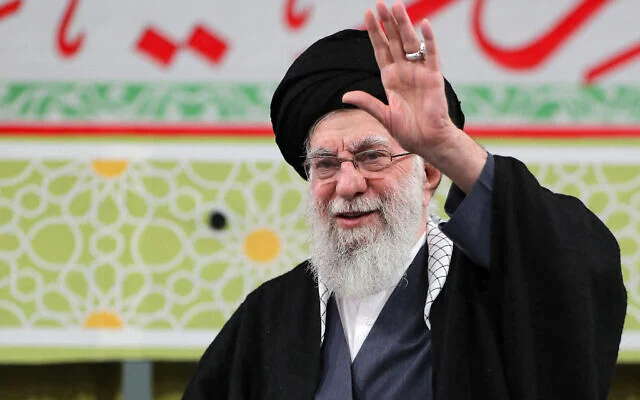
Iran’s Supreme Leader Ayatollah Ali Khamenei said Sunday that if the US attacks Iran, the hostilities will broaden into a regional conflict, the semi-official Tasnim news agency reported.
“The Americans should know that if they start a war, this time it will be a regional war,” Khamenei was quoted as saying.
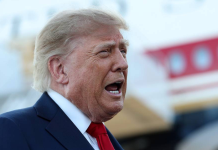
The has US built up its naval presence in the Middle East, with President Donald Trump repeatedly threatening Iran with intervention if it does not agree to a nuclear deal or stop killing protesters.
“[Trump] regularly says that he brought ships… The Iranian nation shall not be scared by these things, the Iranian people will not be stirred by these threats,” Khamenei said.
“We are not the initiators and do not want to attack any country, but the Iranian nation will strike a strong blow against anyone who attacks and harasses them.”
The comments from the 86-year-old Khamenei were the most direct threat he’s made so far.
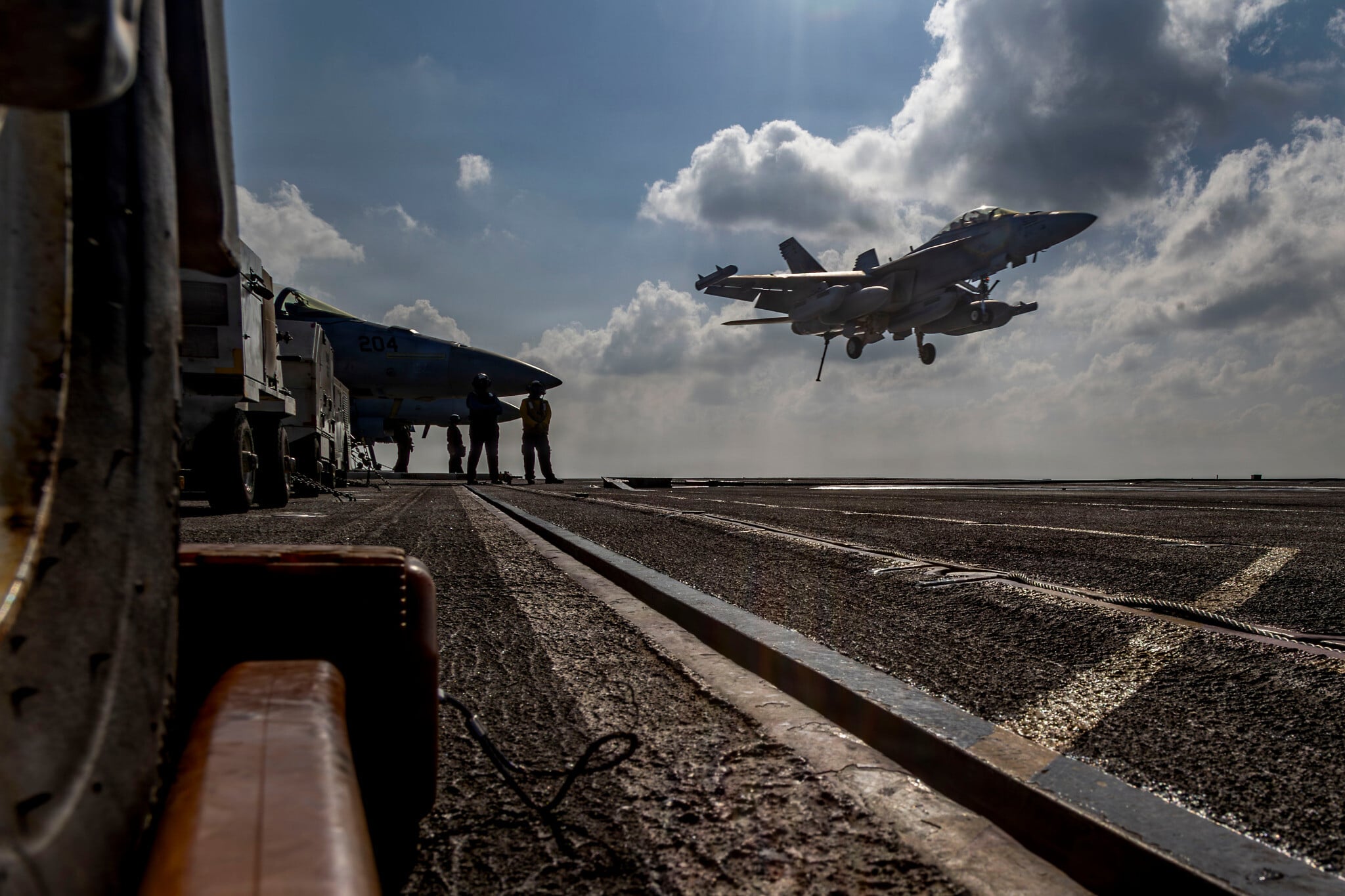
flight deck of the Nimitz-class aircraft carrier USS Abraham Lincoln in the Indian
Ocean on Jan. 23, 2026.
Tehran has warned that if Trump orders strikes, Iran will target Israel and American military assets in the Middle East.
A diplomatic solution remains in the cards, with Tehran saying it is ready for “fair” negotiations that do not seek to curtail its defensive capabilities.
Trump said Saturday that Iran is “seriously talking” with Washington.
Khamenei also likened recent anti-government protests to a “coup,” saying that the goal of the “sedition” was to attack the centers that govern the country, state media reported.
“They [rioters] attacked the police, government centers, IRGC centers, banks, and mosques, and burned the Quran… It was like a coup,” he said, adding that “the coup was suppressed.”
The Iranian authorities’ deadly response to the protests sparked threats of intervention from Trump, who dispatched an aircraft carrier group to the region.
The US Navy currently has six destroyers, one aircraft carrier, and three littoral combat ships in the region.
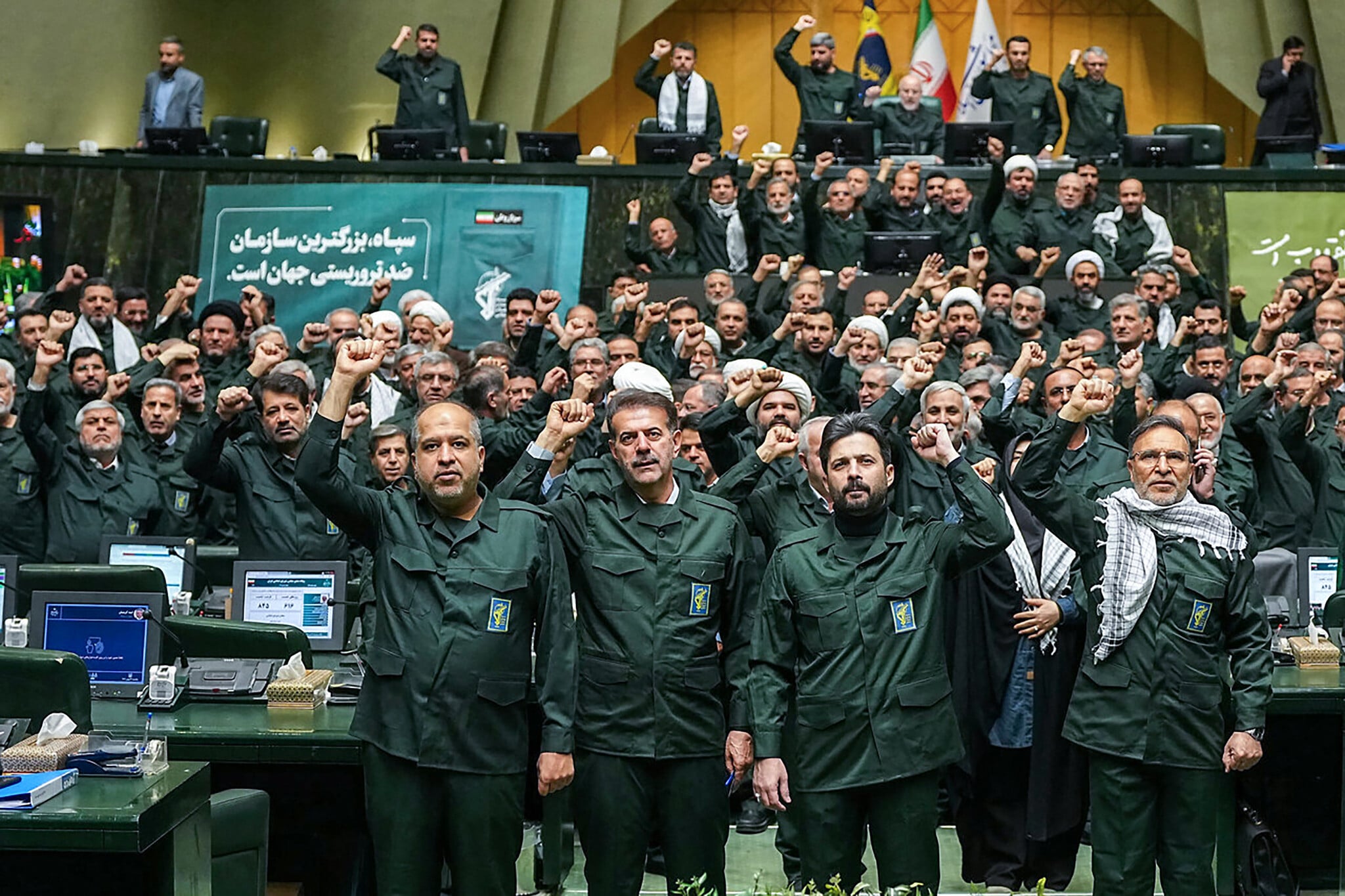
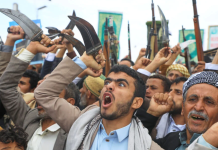
Agencymembers of Iran’s parliament dressed in IRGC uniforms, chant
‘Death to America, Death to Israel’ during a session in Tehran on February 1, 2026
The protests, which started in late December over economic hardships but morphed into the most acute political challenge to the Islamic Republic since its establishment in 1979, have now abated after repression.
Official numbers put the unrest-related death toll at 3,117, while US-based HRANA rights group said on Sunday it had so far verified the death of 6,713 people. Reuters was unable to independently verify the numbers.
The response prompted the European Union to list the Islamic Revolutionary Guard Corps, which played a central role in violently putting down the unrest, as a terrorist organization. Iranian lawmakers retaliated on Sunday by slapping the same designation on European armies.
Lawmakers wore the green uniform of the Guards in a display of solidarity at the legislative session, where they chanted “Death to America,” “Death to Israel” and “Shame on you, Europe,” state television footage showed.
Slamming the bloc’s “irresponsible action,” speaker Mohammad Bagher Ghalibaf said that under “Article 7 of the Law on Countermeasures Against the Declaration of the IRGC as a Terrorist Organization, the armies of European countries are considered terrorist groups.”
It remained unclear what immediate impact the decision would have.
Ghalibaf said the EU decision, “which was carried out in compliance with the orders of the American president and the leaders of the Zionist regime, accelerated Europe’s path to becoming irrelevant in the future world order.”
The move, he added, had only increased domestic support for the Guards.
Sunday’s session was held on the 47th anniversary of the return from exile of the late ayatollah Ruhollah Khomeini, who founded the Islamic Republic in 1979.
The Guards are the ideological arm of Iran’s military, tasked with safeguarding the Islamic Republic from external and internal threats. Set up after Iran’s 1979 Islamic Revolution to protect the Shiite clerical ruling system, the IRGC has great sway in the country, controlling swaths of the economy and armed forces. The Guards were also put in charge of Iran’s ballistic missile and nuclear programs.
The EU on Thursday listed the body as a “terrorist organization,” in part for orchestrating the crackdown on the recent protest movement. The step matched similar classifications enacted by the United States, Canada and Australia.
“Repression cannot go unanswered,” European Union foreign policy chief Kaja Kallas wrote on X. “Any regime that kills thousands of its own people is working toward its own demise.”
France and Italy, which were previously reluctant to list the IRGC as a terror group, lent their backing this week. Israel hailed the achievement of a goal it had long sought.
Foreign Minister Gideon Sa’ar praised the decision as “historic,” calling the IRGC “the number one force behind the spread of terror and the destabilization of the region,” asserting that the move will thwart such activities in Europe and send “an important message to the men and women of the Iranian people who are fighting for their freedom.”
BY: The Times Union