Once again, Gaza has returned to the center of international debate, not through an announcement of peace but through a proposal for management. Under US President Donald Trump’s 20-point peace plan for Gaza, accompanied by strong American messaging and dense organizational language, an old dilemma has resurfaced in a new form: Is the world finally searching for an exit from the Gaza war or merely redesigning the mechanisms used to contain it?
At first glance, the plan, which is now entering its second phase, appears ambitious. It speaks the language of coordination, stability, reconstruction and postwar governance. It suggests international oversight, regional participation and an administrative framework that would, in theory, prevent Gaza from sliding back into chaos once the fighting subsides. Yet beneath this polished surface lies a deeper, unresolved tension — one that has haunted every previous attempt to “solve” Gaza without confronting its political core.
The idea of international or quasi-international management of Gaza is not new. Variations of it have surfaced repeatedly over the past two decades, particularly after each major escalation. What changes are the labels, the actors involved and the institutional architecture. What remains constant is the underlying assumption: that Gaza can be stabilized administratively while its political status remains suspended.
This is precisely where skepticism begins.
The proposed framework appears less like a peace initiative and more like an advanced crisis-management model
Dr. Abdellatif El-Menawy
The proposed framework appears less like a peace initiative and more like an advanced crisis-management model, designed to control fallout, distribute responsibility and prevent total collapse. It focuses on how Gaza might be governed, rather than why it has repeatedly reached this state. In doing so, it risks treating the symptoms of the conflict while carefully avoiding its causes.
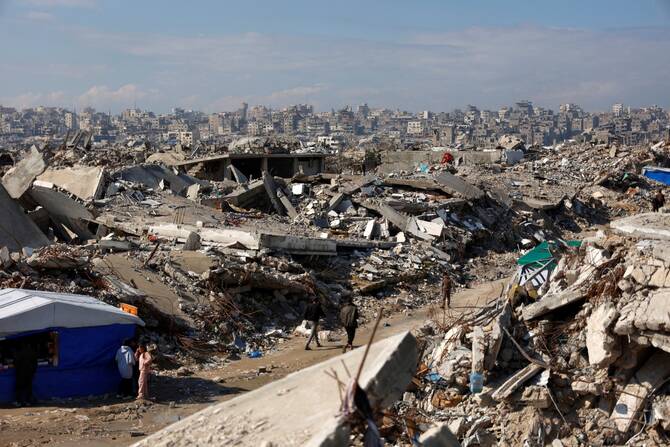
At the heart of Gaza’s tragedy is not merely destruction, humanitarian collapse or security breakdown. It is a persistent political vacuum — the absence of a credible, agreed-upon political horizon for Palestinians in Gaza that is connected to the broader Palestinian question.
Any proposal that isolates Gaza from the West Bank or treats it as a standalone administrative problem implicitly reinforces fragmentation. Even if unintentionally, such approaches risk normalizing the idea that Gaza can be governed indefinitely without resolving issues of sovereignty, representation, borders or occupation.
This is why many observers view the latest concept with caution. It may offer order without justice, calm without resolution and stability without legitimacy.
The strong American endorsement of the proposal reflects a growing impatience in Washington. After months of war, humanitarian catastrophe and international pressure, there is a clear desire to move from active conflict to controlled aftermath. From this perspective, the priority is preventing Gaza from becoming an ungovernable space that destabilizes the region.
However, urgency is not the same as strategy.
By emphasizing managerial solutions, the US appears focused on preventing immediate deterioration rather than investing in the difficult, politically costly work of redefining the conflict’s parameters. This may be understandable in the short term — but history suggests it is insufficient in the long run.
For regional players, the proposal presents a dilemma. Participation offers influence and a chance to shape outcomes, but it also carries significant risks. Any regional or international body involved in governing Gaza without a clear political mandate could quickly find itself blamed for failures it did not cause and unable to make decisions it does not control.
There is also a deeper concern: Does international management become a substitute for political accountability? If so, Gaza risks becoming a permanent international trusteeship in everything but name — managed, monitored and funded but never truly resolved.
The danger lies in allowing the language of ‘peace management’ to replace the pursuit of peace itself
Dr. Abdellatif El-Menawy
The most troubling aspect of the proposal is the possibility that it represents not a breakthrough but a repackaging of stalemate. By focusing on mechanisms rather than meaning, structures rather than solutions, the international community may once again be choosing the path of least resistance.
This would not be the first time Gaza has been “saved” from collapse only to be returned, months or years later, to the same cycle of destruction. Each iteration becomes more complex, more institutionalized and paradoxically harder to dismantle.
None of this is to dismiss the need for immediate stabilization. Gaza undeniably requires security arrangements, reconstruction, humanitarian relief and administrative order. But these steps can only be sustainable if they are clearly linked to a political process that addresses Palestinian unity, territorial integrity and a viable future beyond emergency management.
The danger lies in allowing the language of “peace management” to replace the pursuit of peace itself.
Ultimately, the debate over the peace plan is not about its technical details. It is about intent. Is the world attempting to end a war or merely to manage its consequences more efficiently?
If the proposal evolves into a bridge toward a genuine political settlement, it could mark a meaningful step forward. But if it remains confined to administrative engineering, detached from the broader Palestinian question, it risks becoming yet another chapter in Gaza’s long history of postponed solutions.
Gaza does not suffer from a lack of plans. It suffers from a lack of political courage. Until that changes, even the most sophisticated frameworks may do little more than recycle the crisis under a new name.
BY: Writer Dr. Abdellatif El-Menawy has covered conflicts worldwide. He is the author of “The Copts: An Investigation into the Rift between Muslims and Copts in Egypt.
Disclaimer: Views expressed by writers in this section are their own and do not necessarily reflect The Times Union‘ point of view