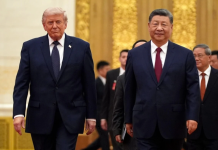
Crown Prince Mohammed bin Salman’s visit to the US was very successful. In addition to securing agreements, he managed to cut the string that bound American arms exports to Israeli preference. President Donald Trump publicly promised that the Kingdom would receive the best products from American factories. Furthermore, Trump is collaborating with the crown prince to develop a nuclear industry in the Kingdom, thanks to its substantial uranium reserves. Consequently, Israel experienced a decrease in its long-standing favored status with the American administration.
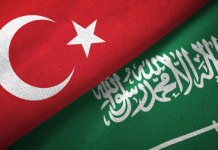
Additionally, the crown prince stood firm against the push for normalization with Israel. He clearly stated his belief that the Palestinian state must be established before any normalization with Israel can occur. Since then, observers of events have noticed Israeli Prime Minister Benjamin Netanyahu’s Zionist mouthpieces barking a fantastical refrain, along with Israel-friendly Arab gadflies who repeat it. They claim that the Kingdom is shifting its political stance to align with what they label as the extremist Islamist approach of countries like Qatar, Turkiye and Iran. Some even suggest an alignment with the Muslim Brotherhood ideology. What a mockery this barking provokes.
The Kingdom, led by the crown prince, under the guidance of King Salman, plays a crucial role in leading the Islamic world toward the right doctrinal path. It is worth mentioning that the Saudi authorities, during the late King Abdullah’s reign, classified the Muslim Brotherhood as a terrorist organization, along with groups like Daesh (ISIS), or “Fahish” (obscenity) as I have termed it, since it emerged from the depths of vulgarity.
Since the events of Sept. 11, 2001, the Kingdom has been at the forefront of the fight against terrorism and extremist ideology. It played a pivotal role in proposing the creation of a counterterrorism department at the UN, setting up a reformation and rehabilitation center in Riyadh for those seeking repentance from extremist ideology and uniting Islamic countries under the Islamic Military Counter Terrorism Coalition in Riyadh. This coalition, comprising more than 40 countries, serves as a platform for consultation and the sharing of experiences in combating terrorism.
Since its foundation, the Kingdom has been subjected to malicious accusations from those who resent its achievements.
Prince Turki Al-Faisal
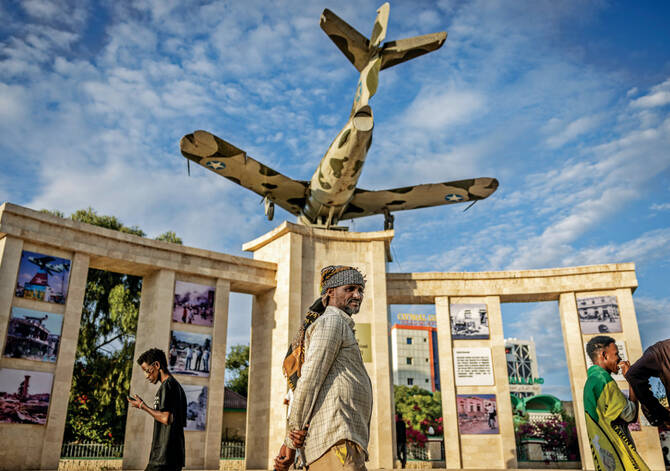
Netanyahu has now adopted a reprehensible approach aimed at disrupting the geographical cohesion of Arab nations. This strategy begins with Syria, where he asserts a desire to safeguard minority groups like the Druze and Christians from their fellow citizens. He is doing this while he is committing genocide against the Palestinian people. His actions extend to Somalia, through the unilateral recognition of the self-declared entity of “Somaliland” as an independent state. Aidarous Al-Zubaidi aspires for independence in southern Yemen while stating that he is amenable to cooperation with Israel.
Since its foundation by King Abdulaziz, the Kingdom has been subjected to malicious accusations from those who resent its achievements in prosperity, stability and the promotion of its high principles, rooted in the monotheistic doctrine: “There is no god but God, and Muhammad is the Messenger of God.” During the era of Nasserism, the Kingdom faced accusations of being reactionary, labeled as a secular country by the Islamist extremists, and branded as a terrorist country by certain Western entities.
Nevertheless, it continues to tread the righteous path — not leaning toward the East or to the West, as mentioned by the late King Faisal. Our king and his crown prince persistently ward off the threats posed by our adversaries, guiding the Arab and Islamic world with wisdom and steadfast determination.
And success is granted by God.
BY: Prince Turki Al-Faisal is the former director general of Saudi Arabia’s intelligence agency and a former ambassador. He is also the founder and Trustee of the King Faisal Foundation and Chairman of the King Faisal Center for Research and Islamic Studies.
Disclaimer: Views expressed by writers in this section are their own and do not necessarily reflect The Times Union‘ point of view