For those trying to get to grips with the dynamics inside Syria more than a year since Bashar Assad fled the country, recent events in Aleppo, the country’s second-largest city, are arguably more instructive than what is happening inside Damascus. This has featured a conflict between government-linked forces and fighters from the Kurdish-dominated Syrian Democratic Forces.
This was not a full-on war between the Syrian government and the SDF. All sides seem to want to avoid this, for now at least. Hitherto, when government-SDF negotiations are fraught, tensions in Aleppo ratchet up. It is the negotiations continuing by other means.
Who started it and who is responsible comes down almost to a case of which party one believes. Claims and counterclaims have run riot. The sides can agree on very little. “A limited and targeted law-enforcement operation” was the position of the Syrian government.
The drone attack on the Aleppo governorate building was a major step change. It took place during an official government press conference given by three ministers. This was one of several drone attacks in the west and center of the city. The government claimed it was carried out by the SDF, using Iranian-made drones.
Despite the displacement of about 155,000 Syrians and the deaths of at least 22 people, this could have been far worse – Chris Doyle
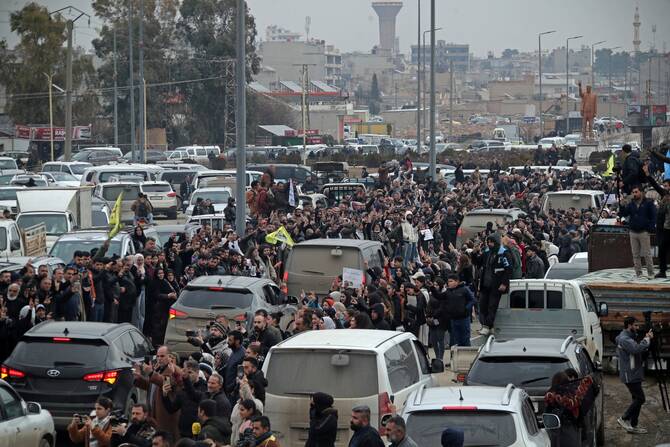
The Syrian government has claimed that all SDF forces have been cleared out of Aleppo. This is largely true but pockets do remain. According to the Syrian government, many SDF fighters were bussed out of Aleppo to the northeast. The SDF initially denied this.
The reality is that, despite the displacement of about 155,000 Syrians in midwinter and the deaths of at least 22 people, this could have been far worse. Hopefully, the violence will recede and a ceasefire respected. But nothing can be taken for granted, not least if the underlying political issues are not resolved.
The Syrian authorities are surging forward with increased confidence. But clearing Aleppo is a whole different ball game to venturing into the east and northeast of Syria, areas dominated by the Kurds, albeit with many divisions. That would be a bloody entanglement, potentially sowing further seeds of conflict for years to come.
The Trump administration made it clear that its lifting of sanctions against Syria was dependent on the government being more inclusive. American officials will not tolerate clashes with their ally against Daesh, the SDF. Their preference is for a political deal and for both parties to fight Daesh in Syria. Remember that the Syrian government joined the anti-Daesh coalition after President Ahmad Al-Sharaa’s historic meeting with Donald Trump in the Oval Office last November.
For any state like Syria, which has so many identity groups, the armed forces must be truly national and representative – Chris Doyle
What are the political obstacles? In March last year, the government and the SDF signed what was described as a historic agreement aimed at integrating the Kurdish-led forces and the areas they control into the Syrian state. But many in the Kurdish communities told me at the time that they were spooked and terrified by the massacres that took place in the coastal regions among Alawite communities.
What might be required for the Syrian government and the SDF to return to genuine negotiations? Disputes have centered on how the SDF’s forces would be absorbed into the national army, its command structures and who would control specific territory and borders.
The armed forces and security services are central to this. For any state like Syria, which has so many identity groups, the armed forces must be truly national and representative — a force that all communities respect as a body that will protect them equally. This is far from the case currently, although the government has made some welcome moves recently by appointing Alawites into roles such as the head of police in the northwest city of Qardaha, the birthplace of Hafez Assad.
Yet the real issue is that a highly centralized government in Damascus, which remains in a fragile state, is seeking full national control while facing, in the SDF, a body that seeks a decentralized, even federal solution to Syria’s governance.
Still, the outside world has levers on all parties. It is time to use them and nudge all parties toward making the necessary compromises. It will require iron-clad guarantees and commitments, but this is essential to any viable future for Syria.
BY: Writer Chris Doyle is director of the Council for Arab-British Understanding in London.
Disclaimer: Views expressed by writers in this section are their own and do not necessarily reflect The Times Union‘ point of view