- South American country was the first to sever ties with Israel after October 7; election of center-right President Rodrigo Paz this year heralded a change
Israel and Bolivia restored diplomatic relations on Tuesday, the latest sign of a dramatic geopolitical realignment underway following the entry of a right-wing government in the South American country that was once among the most vocal critics of Israeli policies toward the Palestinians.
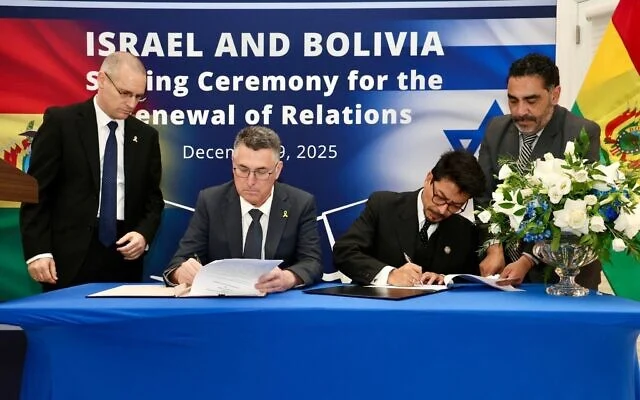
Foreign Minister Gideon Sa’ar met his Bolivian counterpart, Fernando Aramayo, in Washington to sign a declaration agreeing to revive bilateral ties, which Bolivia’s previous left-wing government severed two years ago over the Israel-Hamas war in Gaza. The ceremony took place at the residence of Ambassador to the US Yechiel Leiter.
“Today, we are ending the long, unnecessary chapter of separation between our two nations,” Sa’ar said in a speech at the signing ceremony. “For many decades, our two nations enjoyed warm diplomatic relations. The renewal of our ties is an important and welcome step. Israel is committed to working closely with the Bolivian government in areas that serve both our nations.”
Bolivia’s Foreign Ministry posted, “Bolivia and Israel fully restore their diplomatic relations and open a new stage of strategic cooperation.”
The restoration has been nearly two months in the making.
Sa’ar held a phone call with Bolivian President Rodrigo Paz a day after the center-right candidate’s election in October, conveying Israel’s desire “to open a new chapter” and fully renew diplomatic relations. In turn, Paz stated his intention “to lead Bolivia toward a reopening to the world and reestablishing ties with Israel.”
In November, the Foreign Ministry’s director general, Eden Bar-Tal, represented Israel at Paz’s inauguration in Bolivia, the ministry said.
This month, Bolivia announced the cancellation of its visa requirement for Israeli travelers, and over recent weeks of intensive contacts, according to the ministry, the countries finalized the agreement to restore ties.
Bolivia’s ministry said the two countries would reinstate ambassadors in the near future and dispatch officials on visits.
As part of a new foreign policy strategy under Paz, the rapprochement “represents a return to trust, intelligent cooperation and the ties that have always existed, but which are now being revitalized with a modern perspective,” the Bolivian ministry said in a statement after the Washington meeting.
Aramayo, as well as Bolivian Economy Minister José Gabriel Espinoza, launched this week into a whirlwind of meetings with American officials as their government works to warm long-chilly relations with the United States and unravel nearly two decades of hardline, anti-Western policies under the Movement Toward Socialism, or MAS, party that left Bolivia economically isolated and diplomatically aligned with China, Russia and Venezuela.
Sa’ar is also due to meet with American officials, including Secretary of State Marco Rubio.
The MAS party was founded by Evo Morales, the charismatic former coca-growing union leader who became Bolivia’s first Indigenous president in 2006. In 2009, under Morales, Bolivia cut ties with Israel in protest of the 2008-2009 Gaza conflict.
When protests over Morales’s disputed 2019 reelection prompted him to resign under pressure from the military, a right-wing interim government took over and restored full diplomatic relations with the US and Israel as it sought to undo many of Morales’s popular policies.
But 2020 elections brought the MAS party back to power with the presidency of Luis Arce. He severed ties with Jerusalem again on October 31, 2023, over Israel’s wartime conduct in Gaza following the Hamas-led invasion and massacre that month. Israel slammed the move as “a surrender to terrorism.”
Other left-wing Latin American countries, like Chile and Colombia, soon made similar moves, recalling their ambassadors and joining South Africa’s case at the International Court of Justice, accusing Israel of genocide. Israel adamantly rejects that accusation.
BY: The Times Union