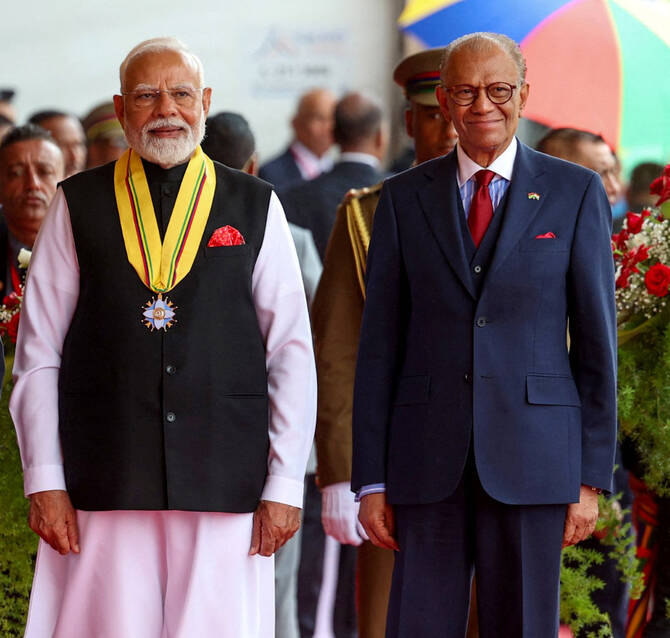
In March this year, during a visit to Mauritius, Prime Minister Narendra Modi announced India’s new maritime vision — “MAHASAGAR,” which means “ocean” in Sanskrit. He said that this acronym stood for “Mutual and Holistic Advancement for Security and Growth Across Regions,” though the geography it embraced was not clarified.
Ten years earlier, Modi had first expounded his maritime vision, “SAGAR” (“sea,” standing for “Security and Growth for all in the Region”), in the same island nation. He has now announced an updated and even more ambitious vision of India’s role in the waters of the Indian Ocean and, possibly, beyond.
India stands at the center of the Indian Ocean. With a coastline of 7,500 km, 12 major ports, more than 200 minor ports and several hundred islands, India’s interests are crucially linked with the ocean, which carries 90 percent of its two-way trade, including most of its energy imports. Besides this, over the last two decades, India has viewed with concern burgeoning acts of piracy in the Gulf of Aden and off the coast of Somalia, the movement of terrorists by sea into Mumbai before they perpetrated their horrendous attacks in November 2008, and the expanding footprint of international navies in the ocean.
SAGAR was India’s first attempt to project a maritime doctrine that would define its interests in the Indian Ocean and spell out its policy approach. Within this framework, India entered into agreements relating to port access with Oman, Seychelles, Mauritius and Australia, and logistics support agreements with the US, which promoted the interoperability of the navies of the two countries. India’s partners in the Quad maritime arrangement — the US, Japan and Australia — also joined in the Malabar naval exercises off the Indian coast. SAGAR thus marked India’s shift from “using the seas” to “securing the seas.”
The new MAHASAGAR doctrine builds on the achievements of SAGAR both in terms of content and the scope of its territorial ambitions. One, it seeks to place India as a credible first responder in times of crisis and as a preferred security partner for the littoral states. To this end, it envisages a stronger and more diverse security role that includes more exercises with different partners, greater defense cooperation and intelligence-sharing, and collaboration to combat nonconventional threats.
Two, it envisages an expansion of economic cooperation, including new supply-chain networks, and capacity-building and skill development with partner nations in maritime infrastructure, renewable energy, climate change and handling disasters. Finally, it involves the increased use of soft power, such as the promotion of educational, cultural and technological cooperation to boost ties across the region.
An immediate result of MAHASAGAR has been the Africa-India Key Maritime Engagement, under which India in April conducted naval exercises with 10 African nations, followed by surveillance missions involving African and South Asian navies, joint patrols in exclusive economic zones and training and humanitarian exercises.
However, MAHASAGAR as a new maritime initiative faces several challenges. As of now, it is a vision. For it to have any operational value, it needs to be shaped into a long-term strategy, with detailed time-bound action plans developed through consultations among diverse stakeholders. This would include, above all, clarifying the geographic boundaries within which vision will be implemented. Commentators believe that the new doctrine embraces the Global South, but its operational space should remain flexible and expand in response to changes in the geostrategic landscape.
This is much too vague. For India to be accepted as a preferred security partner, it is important to define the space within which MAHASAGAR will be operationalized and the Indian Navy, as the implementing authority, assigned a precise role in this territory, with adequate resources provided so it can fulfill its mission. The Global South, while alluring, is much too ill-defined, ill-organized and deeply divided for it to be the arena for an effective maritime role. In these early days, it would make sense to restrict the new initiative’s operational space to the Indian Ocean and its littoral areas.
To avoid losing credibility among its partners, India should also remain mindful of the gap between its aspirations and its capabilities. While its maritime prowess has witnessed remarkable progress over the last two decades, it is still a long way from emerging as the preferred regional security partner that MAHASAGAR envisages as its ultimate accomplishment. While its capabilities are evolving, a dose of modesty would be a more practical approach than grandiose rhetoric that is unconnected to real capabilities.
Again, there is a need to be cautious about partnerships with Western nations. As Indian naval affairs commentator Anoop Verma has noted, Western countries’ maritime support for India is “conditional, selective and aligned with their own broader strategic agendas.” India will need to be alert to encroachments on its strategic autonomy.
Finally, it should be kept in mind that MAHASAGAR envisages partnerships in diverse areas — political, defense, economic and cultural. Hence, every effort needs to be made to move beyond security issues and pursue economic and technological engagements, along with educational and cultural exchanges.
This is a bold and exciting vision that defines the path forward in realizing India’s interests in the competitive arena of the Indian Ocean. Policy initiatives, as set out above, will ensure that this vision will move beyond rhetoric and effectively serve India’s interests and those of the region.
BY: Writer Talmiz Ahmad is a former Indian diplomat.
Disclaimer: Views expressed by writers in this section are their own and do not necessarily reflect The Times Union‘ point of view