Benjamin Netanyahu has his way of dealing with those he perceives as Israel’s enemies. He may have accepted the Gaza ceasefire, but that does not mean that he has to suspend what he believes is his right to kill his enemies. So, he violates the ceasefire and puts the blame on them. He carries out hostile operations, saying they are a retaliation to violations committed by the other side. This is happening in Gaza and in Lebanon. His ultimate priority is to “finish the job,” meaning eliminating any source of danger.
Those who have followed the statements of Israeli officials since the October 2023 attack are not surprised by what Israel did yesterday and the day before that. Those officials have said Israel will not wait for the dangers to mount against it in neighboring countries before it acts. They have asserted that Israel will take the initiative by nipping these dangers in the bud. Israel acts as if it alone has the ability to assess the nature and extent of these dangers.
Moreover, Netanyahu and his top aides have stressed that they are not looking for truces, but rather they want to decide the war in their favor and ensure that it will not erupt again. This means disarming Hamas in Gaza and Hezbollah in Lebanon — which has not happened.
Israeli officials believe that the Oct. 7, 2023, attack gave them the right to go to war to the very end and decide it in their favor. They do not want to go to war with Hamas or Hezbollah again in a year or so.
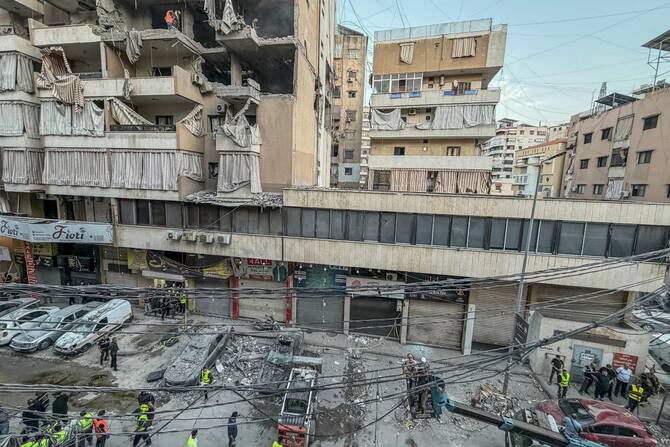
The attack on Beirut’s southern suburbs on Sunday came as no surprise. Reports had claimed Israel was preparing to intensify its military pressure on Hezbollah and Lebanon. Israel views Hezbollah’s rumored attempts to rebuild its capabilities as a violation of the ceasefire and a danger that must be addressed. The Israeli escalation appeared imminent when an American official spoke last week about information that Hezbollah was indeed rebuilding its capabilities.
The winds of war have been blowing for weeks in Lebanon. The Lebanese authorities have been unable to convince the Americans that they have done all they can to implement the decision to impose state authority over arms.
Meanwhile, Hezbollah Secretary-General Sheikh Naim Qassem has been very frank in saying that the party is in no way willing to hand over its weapons. He also said that any talk about the fate of the weapons must be preceded by Israel’s full withdrawal from all Lebanese territories and its release of Lebanese prisoners. And he demanded that discussions over the party’s arms must be strictly Lebanese and not tied to any foreign conditions. This has left Lebanon incapable of providing itself with American protection against the Israeli assaults.
Amid the reports of a possible escalation of Israeli attacks on Lebanon, more and more talk has been taking place about Israel and Iran preparing themselves for a new round of fighting. Tehran has vowed to inflict massive destruction on Israel should it spark a new conflict. Israel, in turn, has threatened to deal Iran even more painful blows than the ones it inflicted in June.
Israel has not ceased its attacks on Lebanon since last year’s ceasefire, explaining that it will not allow Hezbollah to rebuild its capabilities. Sunday’s strike was the most dangerous since the ceasefire was reached. It signaled the return of Israeli attacks on the southern suburb of Beirut known as Dahieh, a Hezbollah stronghold that was the scene of Israel’s assassination of two Hezbollah secretaries-general and other senior military commanders, including former chief of staff Fuad Shukr.
Furthermore, Sunday’s strike targeted Haytham Tabatabai, the aide to the secretary-general, meaning Hezbollah’s chief of staff. He was effectively the party’s second in command and was on Israeli and American wanted lists. Tabatabai’s role went beyond Lebanon, as he was also active in Yemen and Syria.
The Israeli attack puts Hezbollah in a very difficult position. Failure to retaliate will deepen the impression that the balance of power prevents it from waging a new war with Israel, especially after it lost its Syrian outlet, which was its rocket supply route from Iran. The war also demonstrated the extent of Israel’s technological superiority and infiltration of the party. Failure to respond will also emphasize the position of Hezbollah’s opponents that the party has become Lebanon’s weakness, not a source of strength, as was once claimed.
However, should Hezbollah retaliate, it would slip right into the Israeli trap. Israel wants to provoke a battle with the party before it has completed rebuilding its capabilities. The question, though, is what would Iran do should this war erupt? Is it ready to take part to defend its ally? Does Israel believe it necessary to deal Hezbollah a fatal blow before waging a new round of fighting with Iran? Whatever happens, the party knows for certain that the majority of the Lebanese people oppose a new war.
Some believe that it is necessary to go through Iran to discuss the fate of Hezbollah’s arsenal. However, how can we discuss these weapons while Iran itself is embroiled in a dispute with the West over its own arsenal? Obviously, the real solution in Lebanon lies in the state having the sole say over decisions of war and peace. As it stands, Hezbollah and Iran are in no shape to return to war, leaving the party in a crisis. Going to war will deepen its losses, while remaining silent over Tabatabai’s killing will increase demands on it to derive lessons from the major changes that have taken place in the region and to end its military role.
The Lebanese state itself is in crisis. It cannot confront the Israeli attacks and it cannot meet the conditions of the Trump administration so that it can protect Lebanon — namely imposing a state monopoly over arms. Lebanon cannot last long while the winds of war keep blowing. It is in a painful state and its divisions are deep. Moreover, the world has started to grow weary of a patient who lacks the ability to make decisions and who is low on immunity. This patient cannot recover his strength on his own but is also refusing to take international treatments.
BY: Ghassan Charbel is editor-in-chief of Asharq Al-Awsat newspaper.
This article first appeared in Asharq Al-Awsat.
Disclaimer: Views expressed by writers in this section are their own and do not necessarily reflect The Times Union‘ point of view