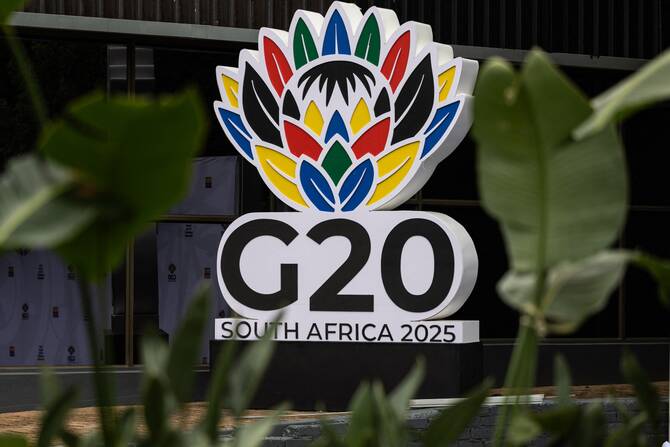
The 2025 G20 Summit, to be hosted by South Africa on Saturday and Sunday, offers a critical opportunity for global leaders to coordinate action on several significant and systemic challenges that are posing risks to economic stability, development and sustainability. Many countries are today facing heightened uncertainty across several sectors, including the economic, environmental and social landscapes.
Some of the key issues to be addressed are global debt sustainability, the urgent need to reform governance structures in major financial institutions, the acceleration of the green energy transition and the reinforcement of food and water security. These issues are not isolated but intertwined, meaning they require coordinated and forward-looking policies to chart a sustainable and inclusive path.
Firstly, global debt levels have risen to unprecedented levels, particularly in low- and middle-income countries, partially thanks to high and rising interest rates. In many developing countries, this issue has left them with limited fiscal space for essential public investment in areas such as health, education and infrastructure. For instance, numerous African nations have seen their debt-to-gross domestic product ratios more than double over the past decade.
This challenge requires multifaceted solutions. One possible method is that a portion of a country’s debt should be converted into funding to directly address issues such as climate adaptation, infrastructure development or social programs. Also, multilateral coordination through institutions such as the International Monetary Fund and World Bank could be strengthened to enhance the effectiveness of debt-relief programs.
In addition, concessional financing and temporary grace periods could provide critical breathing space for developing countries. By implementing some of these measures, the G20 can help prevent debt crises that could have destabilizing consequences far beyond individual countries.
Another challenge to address is the fact that international financial governance structures, particularly within the IMF and World Bank, have historically favored advanced economies at the expense of developing nations. This is despite developing nations constituting the majority of the world’s population. The current rules appear to limit the influence of the countries that are most affected by financial, environmental and developmental shocks. Reform would enhance the legitimacy and effectiveness of multilateral institutions and ease the frustrations of developing nations.
For example, the G20 could expand the representation of underrepresented regions, particularly Africa, Latin America and parts of Asia. This could include increased voting shares and additional board seats to provide direct input into policy and strategy. By ensuring that the voices of developing countries are meaningfully included, the G20 can strengthen the legitimacy and effectiveness of global financial governance. This would also make it a more equitable international system.
The second vital issue to address is the transition from fossil fuels to renewable energy. While the urgency of decarbonization is clear, developing countries face a complex challenge and trade-off: there is the need to maintain economic growth and energy security while investing in clean energy infrastructure. They do not want to undermine the revenue streams that are essential for debt servicing and social spending.
One way to deal with this challenge is to pool multilateral, bilateral and private finance for renewable energy infrastructure, while ensuring that investments support sustainable economic growth and development. The G20 has the capability to ensure a speedy global energy transition that is environmentally sustainable and economically effective, as well as inclusive.
The third issue to address is food and water security, particularly in regions that are facing climate-induced stress and socioeconomic vulnerability. Developing countries often face two challenges at the same time: one is responding to immediate crises, such as droughts or floods, and the other is the need to invest in long-term adaptation strategies. But the problem is the lack of adequate financing and technical expertise.
One solution would be to have a special fund under G20 leadership that supports climate-resilient agriculture, irrigation systems and water infrastructure. The private sector could also bring additional investment and ensure that the practices are economically viable.
Addressing these challenges must extend beyond the countries that are most directly affected. Advanced economies and multilateral institutions must play an active role in providing financing and technical support. This would enable developing countries to build resilience and achieve sustainable development, which would help advanced countries in the long term as well. In addition, trade policies should support equitable access to markets, ensuring that developing countries can capture the benefits of innovation. Through these measures, global powers can safeguard systemic stability by recognizing the fact that crises in one region have global repercussions.
Finally, a failure to address the interconnected challenges of debt, governance, the energy transition and food and water security will have severe long-term consequences, such as triggering sovereign debt crises, undermining global financial stability and generating spillover effects in advanced economies. Moreover, the legitimacy of multilateral institutions will erode, prompting fragmentation of the international system and weakening cooperation in addressing future crises.
In a nutshell, the 2025 G20 Summit in South Africa represents a great opportunity to address several systemic global challenges. The G20 should prioritize debt sustainability, governance reform, the green energy transition and food and water security. This requires the active participation of advanced economies, private sector actors and multilateral institutions in order to ensure that progress is inclusive, effective and sustainable. The summit’s outcomes could have profound implications for global economic stability, environmental sustainability and human well-being.
BY: Dr. Majid Rafizadeh is a Harvard-educated Iranian American political scientist.
Disclaimer: Views expressed by writers in this section are their own and do not necessarily reflect The Times Union‘ point of view