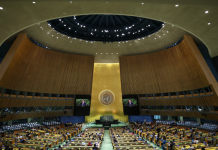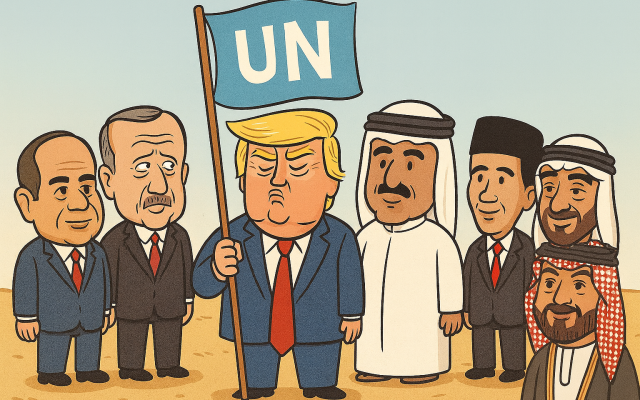
Last week, Washington circulated a draft UN Security Council resolution to establish an International Stabilization Force (ISF) for Gaza. At the time, reporting suggested that elements of the Trump 20-Point Plan were included as an annex — a way to gesture toward political horizons without embedding them in the operative text. That annex carried provisions for an international stabilization presence and a transitional governance mechanism overseen by an international board.
Today, the language has shifted. References to a “credible path” toward Palestinian self‑governance and eventual statehood are now reportedly written directly into the ISF draft resolution. What was once supplementary guidance has apparently become core architecture.
From Ceasefire Mechanism to Political Horizon
The ISF is no longer framed as a narrow ceasefire enforcement tool. By embedding statehood language in the operative text, Washington has transformed the mission into a tangible political horizon. Postwar Gaza is being positioned not only as a security challenge but as a potential stepping stone toward Palestinian sovereignty — contingent on governance reforms, demilitarization benchmarks, and institutional restructuring.
This explicitness matters. The Biden Administration had floated similar horizons, but their language was couched in diplomatic ambiguity. Trump’s draft would make the linkage unmistakable and embedded in international law.
Why the Shift Matters
- Israel: Explicit references to statehood will be politically fraught. Even if Israeli leaders accept an international force, tying it to sovereignty benchmarks raises profound domestic and security concerns.
- Saudi Arabia and the Gulf: For Riyadh and Abu Dhabi, the clarified text may provide the political cover needed to fund reconstruction. Without a credible horizon, their involvement risks being seen as underwriting indefinite occupation.
- Palestinians: The inclusion of a “pathway” is significant precisely because it is a clear U.S. acknowledgment of a political horizon. For many, it reframes the ISF from an imposed regime to part of a transitional process with an end point. For Hamas it could be an opportunity to reframe disarmament from surrender to a concession necessary to advance the aspirations of the Palestinian people.
- Regional mediators: Statehood language strengthens the case for broader Muslim and Arab participation, since the ISF would be linked to Palestinian aspirations rather than merely ceasefire policing.
Normalization Calculus
The timing is deliberate. Trump and Crown Prince Mohammed bin Salman are scheduled to meet next week. Most analysts had dismissed the meeting as a likely non‑event. But today’s development suggests pre‑meeting alignment: Washington and Riyadh appear to have coordinated language in advance.
For MbS, explicit statehood clauses are the threshold for moving forward. If Israel accepts the linkage, Saudi normalization could follow — a breakthrough that would reshape regional diplomacy. If Israel resists, the ISF risks stalling before deployment.
Fragile Architecture, High Stakes
Even with clearer political framing, the ISF remains structurally fragile. Fault lines persist: Israeli mistrust of Turkey, Gulf concerns about Islamist influence, sensitivities around Qatari mediation, and the operational limits of troop contributors. The draft’s conditional language about returning governance to Palestinian authorities — dependent on “satisfactory” reforms — makes the political endgame contested before the mission even begins.
Conclusion
By moving statehood language from an annex to the resolution’s text, Washington has raised the stakes. The ISF is now both a stabilization mechanism and a political test. It offers Arab donors a horizon to justify reconstruction spending, Palestinians a tangible acknowledgment of sovereignty, and Israel a stark choice: accept the linkage and gain historic regional integration, or reject it and risk further isolation.
The coming weeks will determine whether the ISF becomes a stabilizing precedent on the road to Palestinian statehood — or collapses under competing imperatives before deployment.
BY: Writer Mr. Keenan is a retired Middle East Intelligence Analyst who served at NATO and the Pentagon. He lived and worked in the Middle East/North Africa for over 15 years. He is the author of ARABIA – Nine Years in the Kingdom.
Disclaimer: Views expressed by writers in this section are their own and do not necessarily reflect The Times Union‘ point of view